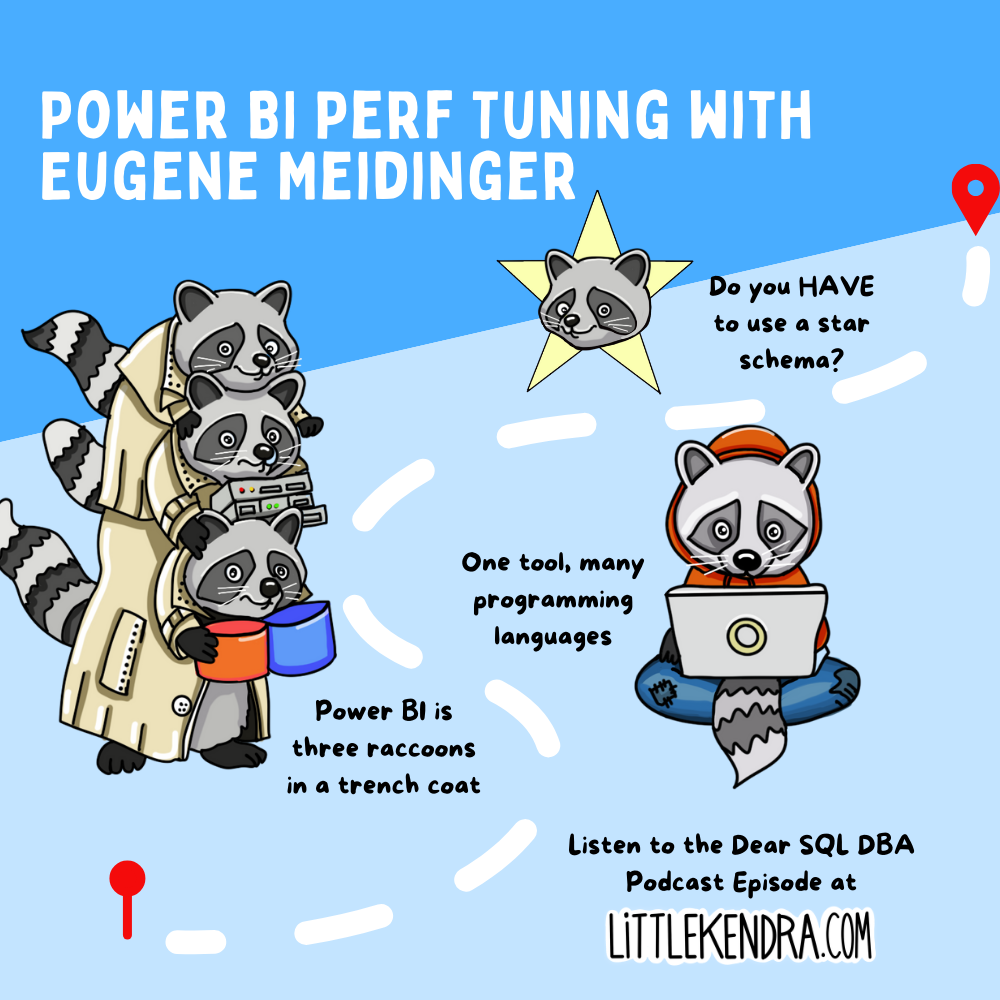
Power BI Performance Tuning with Eugene Meidinger
Eugene Meidinger stops by the Dear SQL DBA Podcast to chat about Power BI Performance Tuning.
We talk about the various engines and languages used in …
Read MoreAre you interested in speaking at the Professional Association for SQL Server’s annual Summit conference?
The call for speakers is now open, and you may submit up to three sessions between now and March 31, 2019.
I’m sketching out my ideas for what sessions that I’d like to submit, and I thought I’d share my process here.

I’m a bit selfish when it comes to topic selection, and I think that’s fine: it needs to be something that I’m interested in thinking about for more than half a year.
That does NOT mean that it needs to be super-advanced rocket science content. Figuring out how to present introductory level content clearly, in an easy-to-understand way takes a lot of time. The topic simply needs to compelling enough for me to stay interested.
When I first began speaking, I thought I needed to speak on topics that were unique to me, which other people in the community didn’t already “have covered.” This led me to somewhat esoteric concepts. There’s a big downside to that: your talks simply won’t be relevant to many people.
Now, I encourage myself (and you) to use the opposite filter: think about talks that will be be helpful to a lot of people. That means you probably won’t be the first one in the world to deliver a talk on the topic, and that’s perfectly fine: your perspective is valuable!
There is definitely a “three bears” aspect to this filter. Your talk doesn’t need to be useful to everyone at the event. But do think about your intended audience, and whether you’ll help a significant portion of the audience at the event.
For this year’s PASS Summit talks, I currently have two topics I’m quite passionate about, which I’d love to share.
Right now I don’t have abstracts. I’ve started by creating notes on:
Here’s where I’m at with my two topics.
Alternate title: I prefer, “How to Standardize Index Code in a Changing World.” Not everyone may get that Standardize = Source Control, however – not sure if that’s simply how I think of it.
Problem summary: It’s critical to get database code standardized into source control to manage collaboration, store and version your organization’s intellectual property, and to track and audit what has happened in your database code. The database code for indexes, however, is increasingly difficult to standardize: new features in Azure SQL DB automate the process of tuning index schema. Single-tenant database architectures often standardize table schemas, but require customizations of indexes for performance in individual databases. And index schema often needs to “drift” in production as operations teams respond to critical performance problems. How do you adapt successfully to this chaos, yet still maintain your sanity by managing your database code in source control?
Topics to include:
Audience / who would care:
Problem summary: There are quite a few discussions and patterns available online for branching application code, but special considerations apply when it comes to database code – and hardly anyone has written about this! This talk helps DBAs and developers design the simplest branching strategy that meets the needs of their organization. I will share key considerations for designing a branching strategy for database code, and we will discuss multiple popular branching models along with “fit notes” describing the strengths and weaknesses of each model.
Topics to include:
Audience / who would care:
I feel pretty good about these topics so far: I think that I care enough about them to want to spend a good amount of time with them, and I think that enough people at the conference care about the problems discussed to make them worthwhile.
These two talks are a bit more focused than talks I’ve done in the past, in that they’re specific to managing code in source control. I’m strongly of the opinion that everyone should be managing their database code in source control, though, so I’m fine with the level of focus – source control should be the norm!
I am presently waiting a few days before writing and revising “real” abstracts. I’ve got some time before the deadline, and I find it’s good that I sit with a topic for a few days to see if a bright new idea occurs to me, or to see if I may want to go in a different direction.
Writing an abstract and choosing a title for a talk can be daunting. I personally find it easier to start with making notes about a potential talk like I’ve shown here, and then refining those notes. I am hoping that helps some potential speakers out there to get started.
Here’s that link to the call of speakers again – submit by March 31, 2019.


Copyright (c) 2025, Catalyze SQL, LLC; all rights reserved. Opinions expressed on this site are solely those of Kendra Little of Catalyze SQL, LLC. Content policy: Short excerpts of blog posts (3 sentences) may be republished, but longer excerpts and artwork cannot be shared without explicit permission.