Blogs

How Many Features Are Missing from Azure SQL Managed Instance?

How Many Features Are Missing from Azure SQL Managed Instance?

By Kendra Little on December 8, 2023 • 8 min read

Category: azure-sql , sql-server

🔥 UPDATE (November 2025): Since this post was written, most Intelligent Query Processing features are now available.
  • According to Microsoft documentation, most Intelligent Query Processing features are now available in Azure SQL Managed Instance, including Cardinality Estimation Feedback, Memory Grant Feedback (percentile), and Parameter Sensitivity Plan Optimization. Some features require specific database compatibility levels.
  • Storage increases: Business Critical service tier now supports up to 16 TB of storage (increased from 4 TB), and the new Next-gen General Purpose service tier supports up to 32 TB. See resource limits documentation for details.
  • Next-gen General Purpose (GPV2) improvements: The new Next-gen General Purpose service tier eliminates the need to configure abnormally large file sizes to get IOPS and throughput. This limitation only applied to the original General Purpose (GPV1) tier, where file sizes determined IOPS and throughput allocation.
Still missing: The following features remain unavailable in Azure SQL Managed Instance as of November 2025, along with most of the features in the post not listed above.

Spoiler: a large amount of features from SQL Server 2022 are missing from Azure SQL Managed Instance. Some major features are missing that were introduced in SQL Server 2019– and here we are just a few weeks away from 2024.

But Microsoft’s top-line marketing claims about Azure SQL Managed Instance remain that ‘it’s always up to date with the latest SQL features and functionality.’

Let’s dig into some of the documented highlights on missing features, so you can decide for yourself what to think of that statement.
Continue reading

Lost Updates Under Read Committed Snapshot Isolation (RCSI)

Lost Updates Under Read Committed Snapshot Isolation (RCSI)

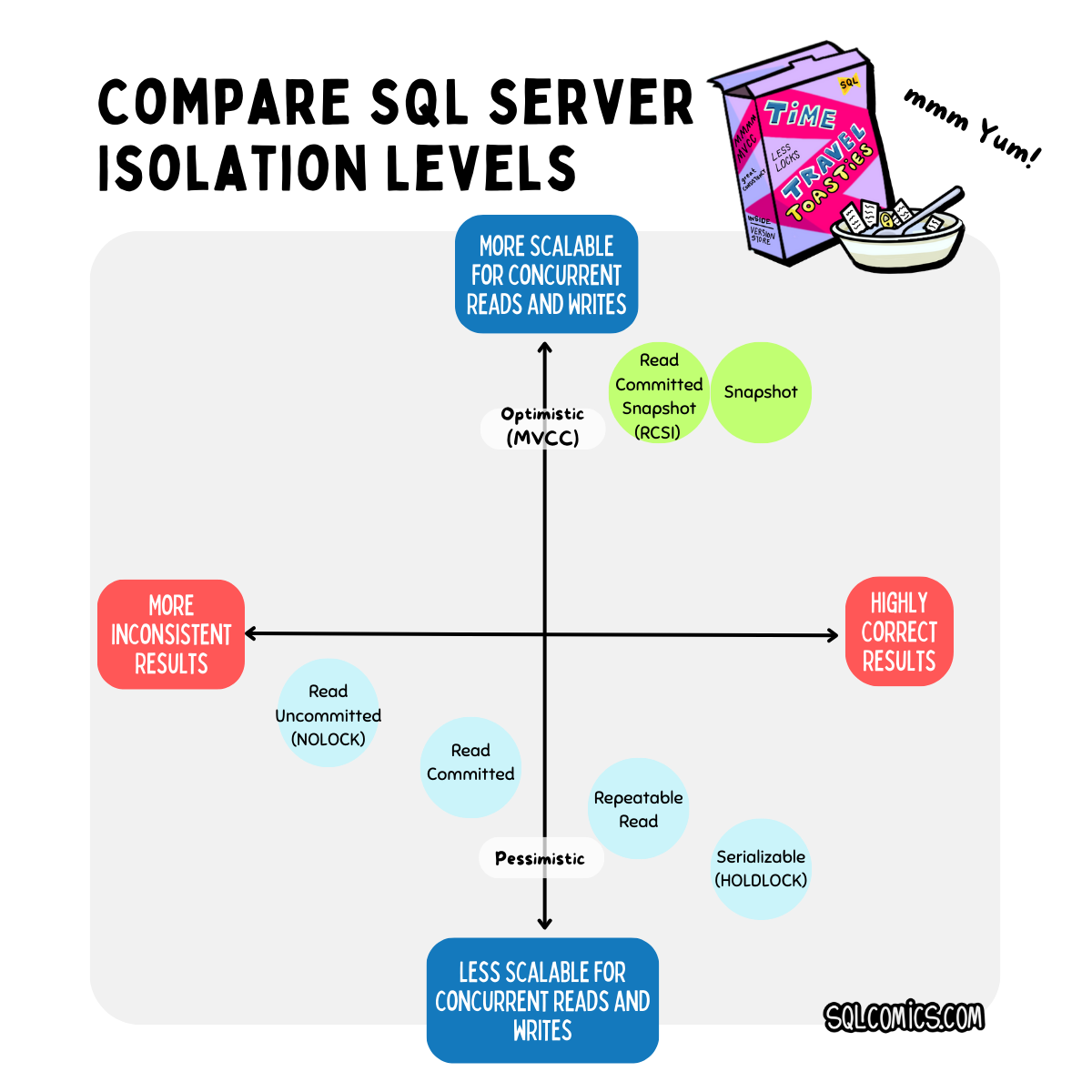
I shared an image on social media this week that describes how I feel about isolation levels in SQL Server (and its various flavors): the more concurrent sessions you have in a database reading and writing data at the same time, the more attractive it is to use version-based optimistic locking for scalability reasons.

There are two isolation levels in SQL Server that use optimistic locking for disk-based tables:

  1. Read Committed Snapshot Isolation (RCSI), which changes the implementation of the default Read Committed Isolation level and enables statement-based consistency.
  2. Snapshot Isolation, which provides high consistency for transactions (which often contain multiple statements). Snapshot Isolation also provides support for identifying update conflicts.

Many folks get pretty nervous about RCSI when they learn that certain timing effects can happen with data modifications that don’t happen under Read Committed. The irony is that RCSI does solve many OTHER timing risks in Read Committed, and overall is more consistent, so sticking with the pessimistic implementation of Read Committed is not a great solution, either.

Continue reading

Automated Deployments and the Art of the Database with Database Michael J Swart

Automated Deployments and the Art of the Database with Database Michael J Swart

By Kendra Little on September 26, 2023 • 1 min read

In this episode, Michael J Swart joins the Dear SQL DBA Podcast to talk about databases, automation, and how he’s come to illustrate some of the coolest blog posts ever to be written about data.

Continue reading

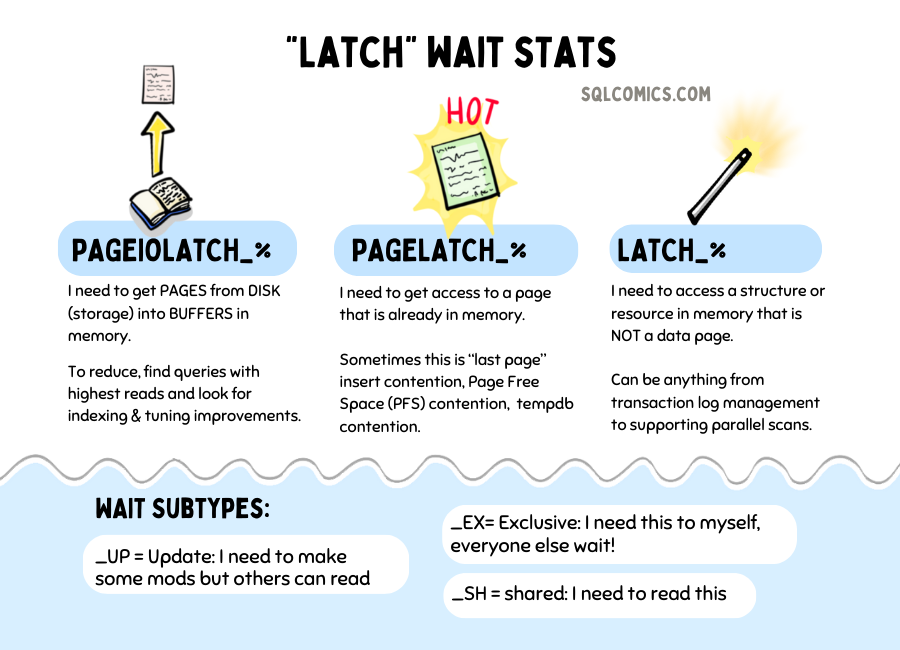
PAGELATCH, PAGEIOLATCH, and LATCH Waits in SQL Server

PAGELATCH, PAGEIOLATCH, and LATCH Waits in SQL Server

I’ve long found it tricky to remember and explain the differences between three similar-sounding waits in SQL Server that all have “LATCH” in the name: PAGELATCH, LATCH, and PAGEIOLATCH waits.

Here’s an illustration that explains these waits, along with wait subtypes.

Continue reading

Jer and Kendar Explore Optimized Locking

Jer and Kendar Explore Optimized Locking

🔥 UPDATE (November 2025): Microsoft has introduced optimized locking v2 with significant improvements. The new version includes Skip Index Locks (SIL) and Query Plan LAQ Feedback Persistence, which further reduce lock overhead. The improvements are most pronounced for nonclustered indexes. Optimized locking v2 is available in SQL Server 2025 and Azure SQL.

SQL Server has a new feature that’s currently only available in Azure SQL Database: Optimized Locking.

Jeremiah Peschka joins Kendra (aka Kendar) to talk through the docs and nerd out on locks, blocks, and how to pronounce the acronym “LAQ”.

Prefer to explore optimized locking with a diagram? I’ve also got a little sketchnote for ya.

Continue reading

Dear SQL DBA - Advice for Technical Leaders with Alex Robson

Dear SQL DBA - Advice for Technical Leaders with Alex Robson

By Kendra Little on August 31, 2023 • 2 min read

Category: career

Ever wondered what it’s like to be a VP or Director of Engineering? I chatted with Alex Robson about leadership in technology, what you can get out of coaching or an MBA program (should you be interested), and what makes a high performing team.

Alex’s site and blog: https://robsonconsulting.services

Continue reading

Msg 195: STRING_SPLIT Is Not a Recognized Built-In Function Name

Msg 195: STRING_SPLIT Is Not a Recognized Built-In Function Name

Yesterday, I was writing some Transact SQL to dust off the cobwebs. I got confused when I was playing around with the STRING_SPLIT function, and kept getting the error:

Msg 195, Level 15, State 10, Line 2
'STRING_SPLIT' is not a recognized built-in function name.

I checked my database compatibility level, which must be 130 or higher for the function to be available. My database compatibility level was 160, so that was fine.

Continue reading