Sql-Server

Category: sql-server

How to Filter RPC_Completed Events in Extended Events: SQL Server Guide

How to Filter RPC_Completed Events in Extended Events: SQL Server Guide

on December 15, 2025

The rpc_completed event in Extended Events is useful when troubleshooting SQL Server performance. It captures detailed information about Remote Procedure Calls: that means stored procedure executions, including the calls to sp_executesql often used by applications (including Entity Framework) to run parameterized queries against SQL Server. The output for rpc_completed includes the parameters that were specified along with values provided, and the CPU time, logical reads, and duration used by the query.

It can be frustrating to figure out how to filter this in Extended Events. Struggling with this is one of the primary reasons I sometimes use ye Olde Profiler for initial investigations and to speedily observe something in SQL Server.

Here is my survival guide to filtering rpc_completed, which makes using XEvents suck less.

Continue reading

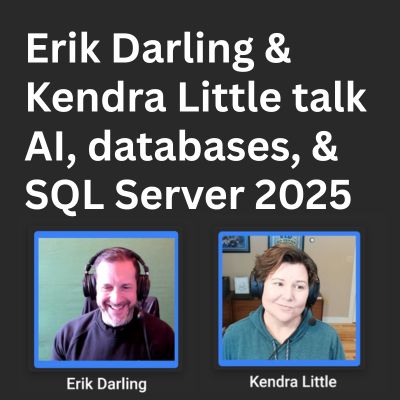
Erik Darling and Kendra Little Talk AI, Databases, and SQL Server 2025

Erik Darling and Kendra Little Talk AI, Databases, and SQL Server 2025

Erik Darling joins me on the Dear SQL DBA Podcast to chat about AI tools, why they work better for Python and PowerShell than SQL, and what’s exciting (and what’s not) in SQL Server 2025.

Along the way we describe the ONE THING we always want to configure in Resource Governor, why at least one SQL Server 2025 feature should be backported to 2022, and whether the universe is text files all the way down.

Continue reading

Azure SQL Managed Instance Memory-to-Core Math Still Doesn't Work, Even in GPv2

Azure SQL Managed Instance Memory-to-Core Math Still Doesn't Work, Even in GPv2

Microsoft recently announced that Azure SQL Managed Instance Next-gen General Purpose (GPv2) is generally available. GPv2 brings significant storage performance improvements over GPv1. If you’re using GPv1, you should plan to upgrade.

But GPv2 still has the same memory-to-core ratio problem that makes Managed Instance a rough deal for running SQL Server. SQL Server is engineered to use lots of memory—it’s a rare OLTP or mixed-OLTP workload that doesn’t need significant cache for reliable performance. We’ll have a look at the pricing math.

Continue reading

How to See Rowcounts and Execution Time for In-Flight Queries in SQL Server

How to See Rowcounts and Execution Time for In-Flight Queries in SQL Server

I frequently need to see rowcounts and execution time for queries while they’re running. Maybe I’m troubleshooting a slow query that’s still executing, or I want to understand which operators are causing the slowdown before the query completes.

Last week at the PASS Summit I learned some little nuances about how this works that I’d missed.

Continue reading

Three Reasons RDS SQL Server Is Better Than Azure SQL Managed Instance

Three Reasons RDS SQL Server Is Better Than Azure SQL Managed Instance

While every managed database service has high points and low points, there are three things that make RDS for SQL Server shine in comparison to Azure SQL Managed Instance: options for a higher memory:vCPU ratio, a well documented API that works beautifully with python, and fast and effective customer support that isn’t painful to use.

It’s just three things, but they make a huge difference. And these are three things that Microsoft can, and SHOULD, really fix for their cloud database services.

Continue reading

Fixing OPTIMIZATION REPLAY FAILED in Query Store: When Plan Forcing Breaks in SQL Server 2022+

Fixing OPTIMIZATION REPLAY FAILED in Query Store: When Plan Forcing Breaks in SQL Server 2022+

Forcing plans with Query Store can be a powerful tool— until it mysteriously fails. In real production systems, plan forcing sometimes just… doesn’t work. One common culprit is the cryptic OPTIMIZATION_REPLAY_FAILED error.

If you’re hitting OPTIMIZATION_REPLAY_FAILED, try re-forcing the plan using @disable_optimized_plan_forcing=1.

Continue reading

Comparing Single Column, Multi-Column, and Filtered Statistics in SQL Server

Comparing Single Column, Multi-Column, and Filtered Statistics in SQL Server

Statistics in SQL Server are simple in theory: they help the optimizer estimate how many rows a query might return.

In practice? Things get weird fast. Especially when you start filtering on multiple columns, or wondering why the optimizer thinks millions of rows are coming back when you know it’s more like a few hundred thousand.

In this post, I’ll walk through examples using single-column, multi-column, and filtered statistics—and show where estimates go off the rails, when they get back on track, and why that doesn’t always mean you need to update everything with FULLSCAN.

Continue reading