Sql-Server

Category: sql-server

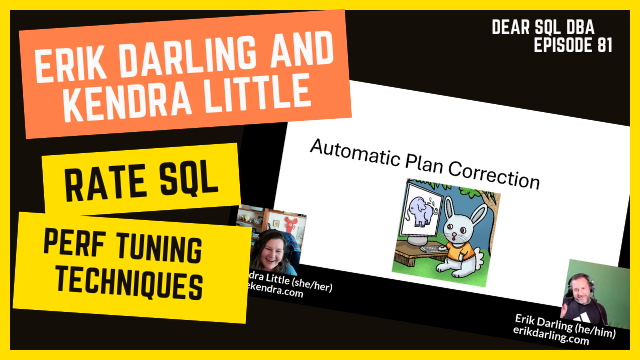
Erik Darling and Kendra Little Rate SQL Server Perf Tuning Techniques

Erik Darling and Kendra Little Rate SQL Server Perf Tuning Techniques

Erik Darling joins Kendra Little to rate different SQL Server Performance Tuning Techniques in episode 81 of the Dear SQL DBA podcast. We share our opinions of… (deep breath)

Recompile hints, Query Store hints and plan forcing, CTEs, Resource Governor, the legacy cardinality estimator, Table Variables, Automatic Plan Correction, Batch Mode, index rebuilds, Hekaton, NOLOCK, page compression, partitioning, filtered indexes, columnstore, join hints, PSPO, indexed hints, indexed views, optimize for unknown, RCSI, adding more memory, restarting the damn thing, scalar UDFs, and Persisted Memory Grant Feedback.

Continue reading

Learn Perf Tuning in 2 Days at PASS Summit 2024 With Erik Darling and Kendra Little

Learn Perf Tuning in 2 Days at PASS Summit 2024 With Erik Darling and Kendra Little

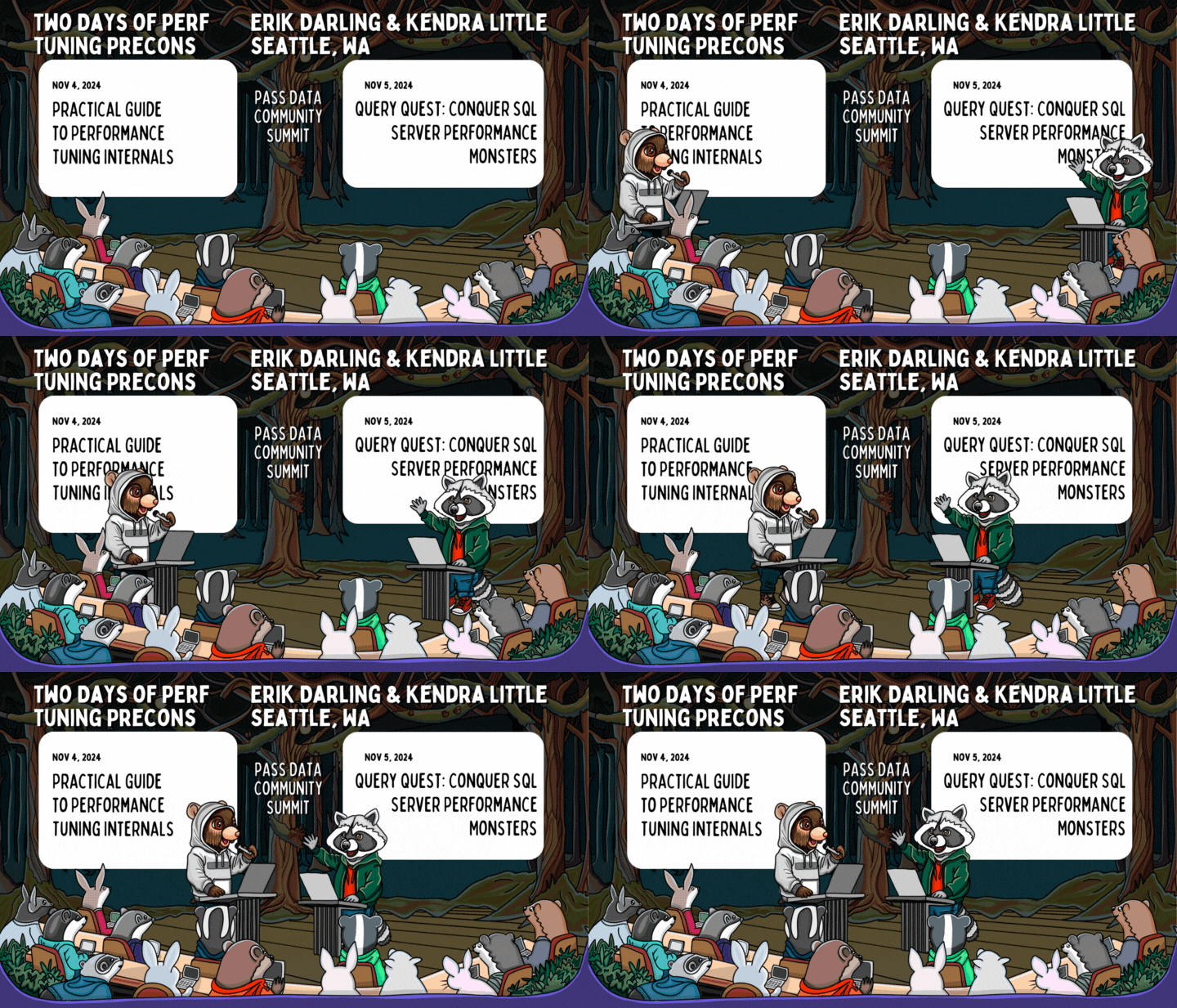
I’m teaming up with Erik Darling to teach you SQL Server Performance Tuning in two days at the PASS Data Community Summit in Seattle.

Erik and I are co-teaching both days of training to give you a strong strategic background on the internals you need to know, along with critical tactical performance tuning techniques. Join us to level up your perf tuning skills!

Continue reading

Query Store Size Based Cleanup Causes Performance Problems - How to Avoid It

Query Store Size Based Cleanup Causes Performance Problems - How to Avoid It

I’m a huge fan of SQL Server’s Query Store feature. Query Store collects query execution plans and aggregate query performance metrics, including wait stats. Having Query Store enabled makes troubleshooting performance issues such as bad parameter sniffing, much, much easier. Because Query Store is integrated into SQL Server itself, it also can catch query plans in a lightweight way that an external monitoring system will often miss.

When performance matters, it’s important to ensure that you’re managing Query Store so that Query Store cleanup does not run during high volume times. Query Store cleanup could slow your workload down significantly.

Continue reading

You Will Not Find Long Compilers Who Time Out in Query Store

You Will Not Find Long Compilers Who Time Out in Query Store

Last November, a puzzle was really bothering me. Some queries from an application were timing out frequently after running for 30 seconds, but they were halfway invisible in the SQL Server.

Continue reading

How to Start an XEvents Trace on a Read Scale-Out Azure SQL Managed Instance

How to Start an XEvents Trace on a Read Scale-Out Azure SQL Managed Instance

It took me more than half hour to figure out how to start an XEvents trace on a read-scale out instance of Azure SQL Managed Instance. It’s hard to monitor read scale-out instances, so tracing is desirable! I started with a simple trace of sql_statement_completed. Hopefully this saves other folks some time.

Continue reading

Should You Use SQL Server Readable Secondaries If Queries Can Fail Repeatedly at Any Time?

Should You Use SQL Server Readable Secondaries If Queries Can Fail Repeatedly at Any Time?

If you use readable secondaries in Availability Groups or Read-Scale out instances in Azure SQL Managed Instance, you may have queries fail repeatedly if there is a glitch and statistics are not successfully ‘refreshed’ on the secondary replica. Those queries may keep failing until you manually intervene.

It’s unclear if Microsoft will ever fix this. There is a well established support deflection article which documents the issue and provides ‘workarounds’.

Continue reading

Azure SQL Managed Instance General Purpose Architecture and Performance/Cost Tradeoffs

Azure SQL Managed Instance General Purpose Architecture and Performance/Cost Tradeoffs

🔥 UPDATE: Microsoft has announced the general availability of the Next-gen General Purpose service tier for Azure SQL Managed Instance, which includes improvements to I/O latency, IOPS, and transaction log throughput. This post describes the original General Purpose blob storage. You don't want that.

Whether or not you use Azure SQL Managed Instance, you will likely be asked for an opinion on it eventually if you’re a SQL Server person.

While the architecture is documented, it can be a bit of a long read and some of the gotchas are spread out over different pages – so I’m drawing up the architecture of each service tier along with notable implications for the design on performance and cost. Here’s the scoop on General Purpose.

Continue reading