
Query-Optimization

Tag: query-optimization

Adaptive Joins and Memory Grants in SQL Server

Adaptive Joins and Memory Grants in SQL Server

Adaptive joins let the optimizer choose between a Hash Join and a Nested Loop join at runtime, which can be fantastic for performance when row count estimates are variable. Recently, when Erik Darling taught two days on TSQL at PASS Community Data Summit, a student asked why a query plan where an adaptive join used a Nested Loop at runtime ended up with a large memory grant anyway.

I didn’t remember the answer to this, but the great thing about co-teaching is that Erik did: adaptive joins always start executing as Hash Joins, which means they have to get memory grants upfront. Even if the query ultimately switches to a Nested Loop at runtime, that memory grant was already allocated. This has real implications for memory usage, especially in high-concurrency environments.

Continue reading

Carrying Baggage Through Query Plans: Why Wide Queries Get Heavy

Carrying Baggage Through Query Plans: Why Wide Queries Get Heavy

I see this pattern repeatedly: a “wide” query that returns many columns and less than 100k rows runs slowly. SQL Server gets slow when it drags large amounts of baggage through the entire query plan, like a solo traveler struggling with massive suitcases in an airport instead of picking them up close to their destination.

SQL Server often minimizes data access by grabbing all the columns it needs early in query execution, then doing joins and filters. This means presentation columns get picked up early.

Continue reading

Slow Storage Can Cause Slow Compilation Time in SQL Server

Slow Storage Can Cause Slow Compilation Time in SQL Server

Up till now, I’ve thought of compilation time in SQL Server as being dependent only on CPU resources– not something that requires fast storage to be speedy. But that’s not quite right.

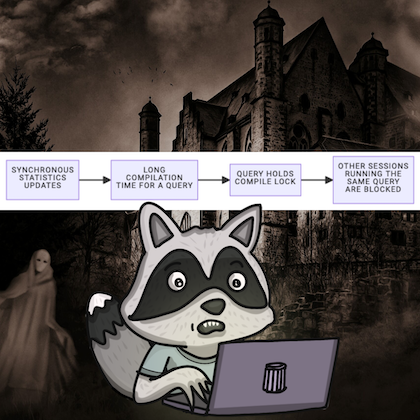
Slow storage can result in periodic long compile time in SQL Server. And long compile time not only extends the runtime for the query, it can also result in blocking with waits for compile locks.

Thanks to Erik Darling for helping me figure this out, and explaining this all in his video, What Else Happens When Queries Try To Compile In SQL Server: COMPILE LOCKS!. For great details and demos, go watch that! I’ll be working through the topic with some simple flow charts here.

Continue reading

Read from the Right End of the Index: BACKWARD Scans

Read from the Right End of the Index: BACKWARD Scans

Optimizing queries is the most fun when you don’t need to add indexes. There’s nothing quite so nice as finding a way to make reading data faster, without slowing down writes or creating new data structures that need to be maintained.

Continue reading