Query-Store

Tag: query-store

How to Trace Trigger Executions with Query Store and Extended Events

How to Trace Trigger Executions with Query Store and Extended Events

Triggers can be tricky to observe in SQL Server. When you need to understand exactly what a trigger is doing and what it impacts, Query Store and Extended Events both have something to offer, but using them effectively requires navigating some confusing nuances. Query Store tracks query-level executions aggregated by query_id, but has a habit of generating a lot of query_ids with different context settings for triggers. Extended Events can capture trigger module starts and individual statement completions within triggers.

This post walks through setting up both observation methods on a test trigger, then compares what each one shows. You’ll see how Query Store data gets spread across multiple query_ids and context_settings_id values, a variety of ways to trace triggers in XEvents, and why the numbers don’t always match up exactly between traces and Query Store.

Continue reading

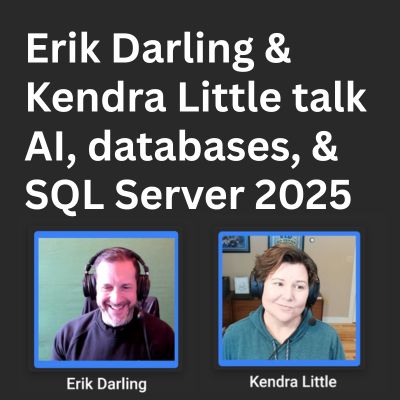
Erik Darling and Kendra Little Talk AI, Databases, and SQL Server 2025

Erik Darling and Kendra Little Talk AI, Databases, and SQL Server 2025

Erik Darling joins me on the Dear SQL DBA Podcast to chat about AI tools, why they work better for Python and PowerShell than SQL, and what’s exciting (and what’s not) in SQL Server 2025.

Along the way we describe the ONE THING we always want to configure in Resource Governor, why at least one SQL Server 2025 feature should be backported to 2022, and whether the universe is text files all the way down.

Continue reading

Fixing OPTIMIZATION REPLAY FAILED in Query Store: When Plan Forcing Breaks in SQL Server 2022+

Fixing OPTIMIZATION REPLAY FAILED in Query Store: When Plan Forcing Breaks in SQL Server 2022+

Forcing plans with Query Store can be a powerful toolβ€” until it mysteriously fails. In real production systems, plan forcing sometimes just… doesn’t work. One common culprit is the cryptic OPTIMIZATION_REPLAY_FAILED error.

If you’re hitting OPTIMIZATION_REPLAY_FAILED, try re-forcing the plan using @disable_optimized_plan_forcing=1.

Continue reading

How to Stop SSDT / Database Projects / SQLPackage from Modifying Database Options

How to Stop SSDT / Database Projects / SQLPackage from Modifying Database Options

SQL Server’s free state-based version control tooling was introduced under the ‘Data Dude’ brand, then became known as ‘SQL Server Data Tools’ (SSDT). Its extension for the (now dying) Azure Data Studio IDE is called ‘SQL Database Projects’. If you need to find documentation, you often need to know to search for specific component names like SQLPackage.exe, which is a command line utility used to deploy SSDT Projects AKA SQL Database Projects.

Continue reading

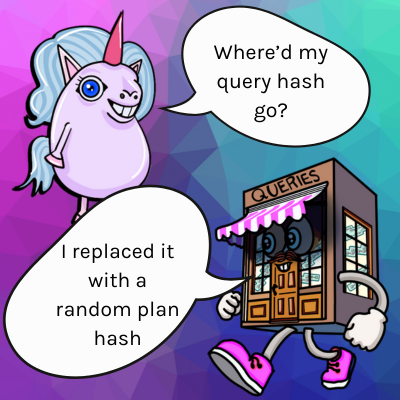
Query Hash Values Are Meaningless in SQL Server: They May Be Reset to Be the Same Value as the Query Plan Hash

Query Hash Values Are Meaningless in SQL Server: They May Be Reset to Be the Same Value as the Query Plan Hash

This is the worst bug I’ve found in SQL Server to date. Previously, my top find was SQL Server Online Index Rebuild sometimes happens offline without warning. This one has taken top slot because it makes my life more difficult on a daily basis.

Background: SQL Server generates a query_hash for each query. This is stored in sys.query_store_query and it’s one of the primary ways you can identify what a query is across different Query Stores, or even the same Query Store over time, as surrogate query_id values get reset if Query Store is cleared or data ages on. The query_hash is a ‘Zobrist hash over the shape of the individual query, based on the bound (input) logical query tree. Query hints aren’t included as part of the hash.’ (Source)

Continue reading

Script to Automate Unforcing Failed Forced Plans in Query Store (SQL Server)

Script to Automate Unforcing Failed Forced Plans in Query Store (SQL Server)

tldr; I’ve published a script to loop through all databases on an instance, identify if there are any query plans in a problematic ‘failed" forced state (which can hurt query performance), and un-force them if found. Get the dbo.dba_QueryStoreUnforceFailed stored procedure on GitHub.

This script is designed to work on SQL Server on-prem, in a VM, or in Azure SQL Managed Instance or SQL Server RDS. Since the script is instance-level and loops through all databases, this isn’t really designed for Azure SQL Database – and you don’t get a SQL Agent there anyway, so you probably want to change this around for that use case. The script is shared under the MIT license, feel free to contribute code and/or adapt away for your own uses.

Continue reading

General Failure Failed Forced Plans in Query Store Cause Even Slower Compile Times

General Failure Failed Forced Plans in Query Store Cause Even Slower Compile Times

πŸ”₯ UPDATE: Microsoft has announced the general availability of the Next-gen General Purpose service tier for Azure SQL Managed Instance, which includes improvements to I/O latency, IOPS, and transaction log throughput. This post describes the original General Purpose blob storage. You don't want that.

This post demonstrates two related bugs with plan forcing in Query Store which increase the likelihood of slower query execution and application timeouts in SQL Server environments.

These bugs are most likely to impact you if:

  • You use the Automatic Plan Correction feature in SQL Server, which automatically forces query plans.
  • Anyone manually forces query plans with Query Store.
  • You have slow storage, which can increase your likelihood of having longer compilation times.

The General Purpose tier of Azure SQL Managed Instance and Azure SQL Database feature both slow storage and Automatic Plan Correction enabled by default. So, weirdly enough, your risks of suffering from this problem are high if you are an Azure SQL customer.

Thanks to Erik Darling for his help in diagnosing and reproducing these issues– and his ‘slow compiler’ query used in this post was incredibly helpful to isolate and narrow down these problems.

Continue reading