Query-Store

Tag: query-store

Slow Storage Can Cause Slow Compilation Time in SQL Server

Slow Storage Can Cause Slow Compilation Time in SQL Server

Up till now, I’ve thought of compilation time in SQL Server as being dependent only on CPU resources– not something that requires fast storage to be speedy. But that’s not quite right.

Slow storage can result in periodic long compile time in SQL Server. And long compile time not only extends the runtime for the query, it can also result in blocking with waits for compile locks.

Thanks to Erik Darling for helping me figure this out, and explaining this all in his video, What Else Happens When Queries Try To Compile In SQL Server: COMPILE LOCKS!. For great details and demos, go watch that! I’ll be working through the topic with some simple flow charts here.


Continue reading

Erik Darling and Kendra Little Rate SQL Server Perf Tuning Techniques

Erik Darling and Kendra Little Rate SQL Server Perf Tuning Techniques

Erik Darling joins Kendra Little to rate different SQL Server Performance Tuning Techniques in episode 81 of the Dear SQL DBA podcast. We share our opinions of… (deep breath)

Recompile hints, Query Store hints and plan forcing, CTEs, Resource Governor, the legacy cardinality estimator, Table Variables, Automatic Plan Correction, Batch Mode, index rebuilds, Hekaton, NOLOCK, page compression, partitioning, filtered indexes, columnstore, join hints, PSPO, indexed hints, indexed views, optimize for unknown, RCSI, adding more memory, restarting the damn thing, scalar UDFs, and Persisted Memory Grant Feedback.

Continue reading

Finally, a SQL Server Monitoring System That Leverages Query Store

Finally, a SQL Server Monitoring System That Leverages Query Store

I’ve spent a bit of time with Microsoft’s new database watcher tool for Azure SQL recently.

There are a lot of things I like about database watcher– which is currently in preview and which refuses to Capitalize Its Name– but it does one big thing that I really, really like: it collects data from Query Store. You can access that Query Store data from built-in database watcher dashboards, query it using KQL, or (something something) in Microsoft Fabric if you’ve got money to burn on your monitoring data.

Continue reading

Query Store Size Based Cleanup Causes Performance Problems - How to Avoid It

Query Store Size Based Cleanup Causes Performance Problems - How to Avoid It

I’m a huge fan of SQL Server’s Query Store feature. Query Store collects query execution plans and aggregate query performance metrics, including wait stats. Having Query Store enabled makes troubleshooting performance issues such as bad parameter sniffing, much, much easier. Because Query Store is integrated into SQL Server itself, it also can catch query plans in a lightweight way that an external monitoring system will often miss.

When performance matters, it’s important to ensure that you’re managing Query Store so that Query Store cleanup does not run during high volume times. Query Store cleanup could slow your workload down significantly.

Continue reading

You Will Not Find Long Compilers Who Time Out in Query Store

You Will Not Find Long Compilers Who Time Out in Query Store

Last November, a puzzle was really bothering me. Some queries from an application were timing out frequently after running for 30 seconds, but they were halfway invisible in the SQL Server.

Continue reading

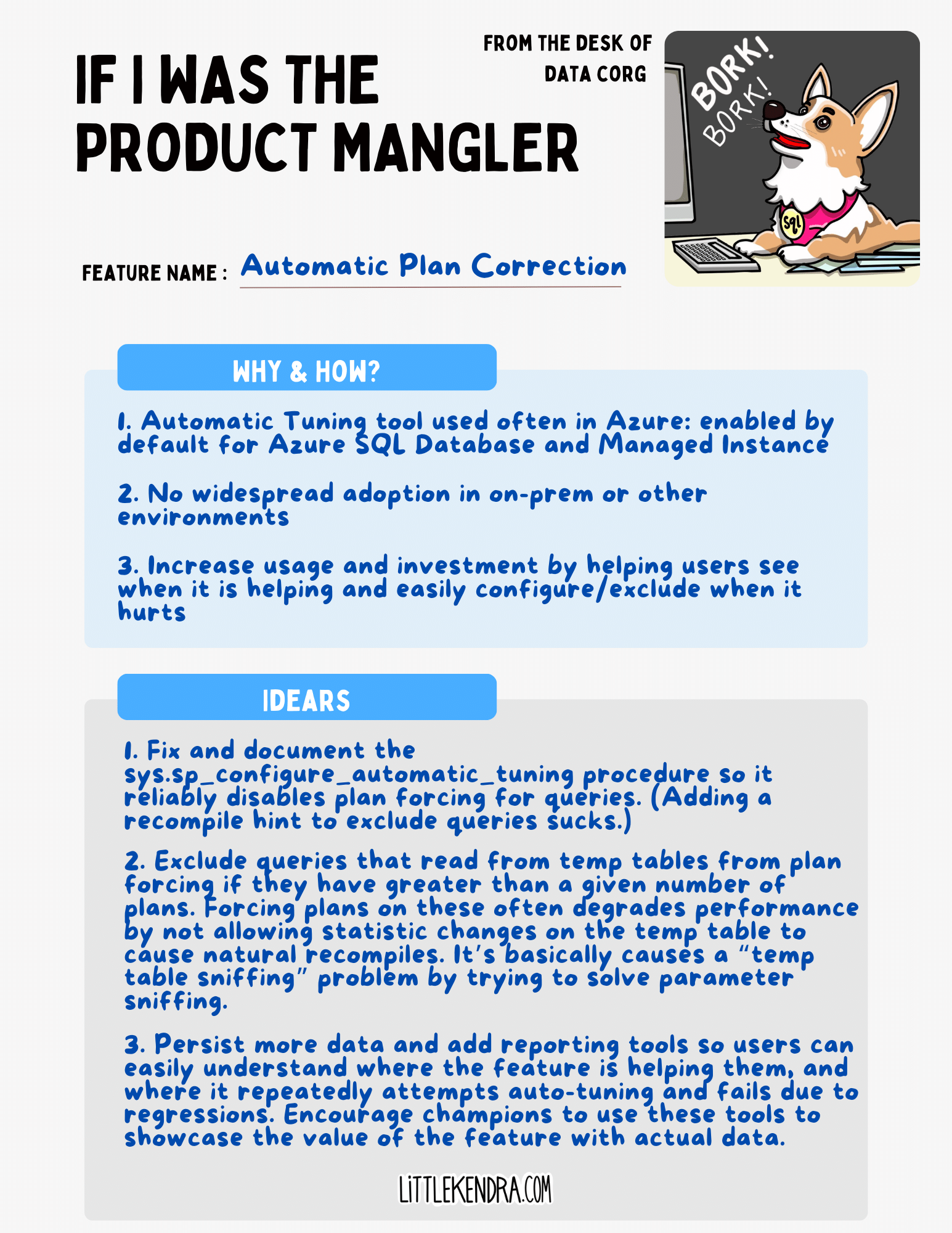
Automatic Plan Correction Could Be a Great Auto Tuning Feature for SQL Server: Here Is What It Needs

Automatic Plan Correction Could Be a Great Auto Tuning Feature for SQL Server: Here Is What It Needs

🔥 UPDATE: The sys.sp_configure_automatic_tuning stored procedure is now documented and supported by Microsoft. Thanks to the SQL Server Product team for this improvement.

I’ve written a bit about SQL Server’s Automatic Plan Correction feature before– I have an hour long free course with demos on Automatic Plan Correction here on the site.

Today I’m updating that course with a note: after using Automatic Plan Correction in anger for a good amount of time, I do not recommend enabling the feature. I’ve had it cause too many performance problems, and there are not a ton of options for an administrator when it’s causing those problems.

Meanwhile, becoming reliant on the feature for the places where it does help makes it difficult to disable the feature. You end up stuck with a very weird set of problems that are oddly similar to the problems the feature was designed to solve.

Further investment in the feature could solve these problems and make this a great tool for customers. Here’s a run down of what Automatic Plan Correction needs from a user who has suffered from it.

Continue reading

Microsoft is Breaking Database Compatibility Levels for SQL Server

Microsoft is Breaking Database Compatibility Levels for SQL Server

According to Microsoft’s documentation, ‘Database compatibility level … allow[s] the SQL Server Database Engine to be upgraded while keeping the same functional status for connecting applications by maintaining the same pre-upgrade database compatibility level."

But these days, the “functional status” of a database at a given compatibility level differs depending on whether you’re using SQL Server, Azure SQL Managed Instance, or Azure SQL Database – and in the hosted versions it may change anytime without notice. Surprise, your database behaves differently now!

The whole concept is breaking down, and this is bad news for users of both managed services and the boxed product.

Continue reading